
Companion guide · 17 October 2026 · Burak Yenigun
MSTR versus bitcoin: the capital structure matters
A worked comparison of senior claims, dilution and the costs of a relative-value hedge.
Download the companion PDF · Download reproducible scenarios
A bitcoin treasury and a bitcoin holding are different exposures. A share in a company sits inside a capital structure. The bitcoin price matters, but so do claims ahead of common shareholders, the number of shares and the terms on which new capital is raised. A valuation premium alone does not tell us the return from buying the stock, holding bitcoin, or trading the two against each other.
This note extends the structural questions in Robert Carver’s original MSTR research with a deliberately small, reproducible example. Every balance-sheet input and trading cost below is hypothetical. This is not a new empirical backtest, a live valuation of Strategy, or a forecast for either security.
1. Start with the claim, then choose the denominator
Consider a fictional bitcoin treasury with $10bn of bitcoin, $1bn of USD assets, $2bn of debt and $1bn of preferred claims. It has 100m basic shares and another 10m potential shares from awards. None of its debt or preferred claims is assumed converted. A $120 share price implies $12bn of basic common-equity market value.
The gross equity-to-bitcoin multiple is 1.20×. An enterprise-style numerator adds $3bn of senior claims and subtracts $1bn of USD assets, giving $14bn / $10bn, or 1.40×. A simplified net-backing calculation instead deducts those same net claims from bitcoin: $10bn − $2bn − $1bn + $1bn = $8bn. That is $80 per basic share and a 1.50× multiple. Across 110m illustrative diluted shares it becomes $72.73 per share and a 1.65× multiple.
All four numbers describe the same fictional company. They answer different questions. Treating them as interchangeable can manufacture an apparent disagreement where the real difference is the numerator, the denominator or the share count. The interactive mNAV comparison lets you change each input and inspect the arithmetic.
Strategy’s current mNAV definition uses price divided by net bitcoin per fully diluted share. Its notes identify a methodology break on 23 July 2026. The earlier enterprise-value definition and the current definition should not be joined into a single comparable series without reconciliation. Our four-convention example is intentionally simpler than either complete company methodology. Sources: current definitions and 31 July 2025 results, checked 17 October 2026.
2. Fixed claims amplify changes in the residual
Hold the fictional company’s debt, preferred claims, USD assets and share count constant. If bitcoin value falls 30%, from $10bn to $7bn, net backing falls from $8bn to $5bn. Net backing per basic share falls from $80 to $50: a 37.5% decline. A 30% rise in bitcoin instead takes the same residual to $11bn, or $110 per share: a 37.5% increase.
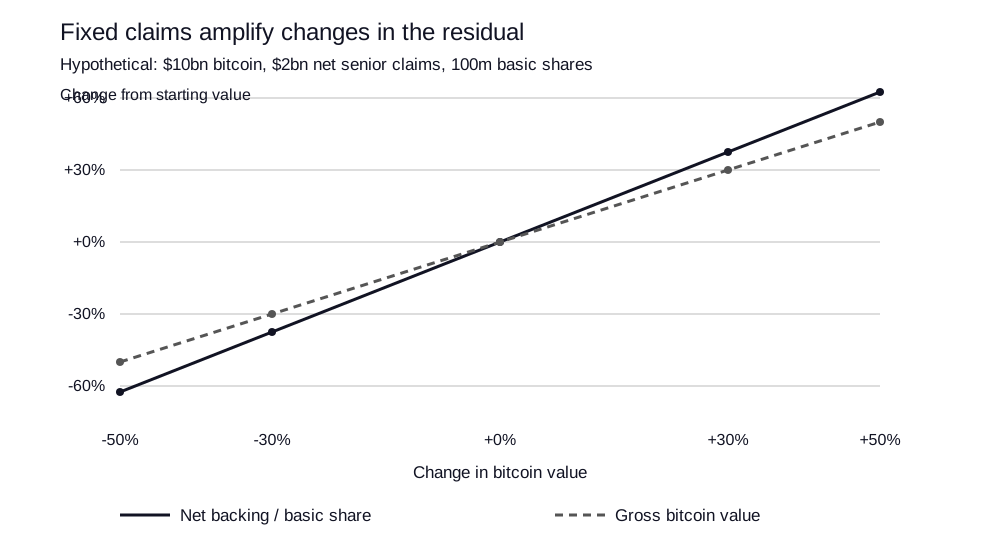
View Figure 1 values
| Bitcoin value | Net backing / basic share |
|---|---|
| −50% | −62.5% |
| −30% | −37.5% |
| 0% | 0% |
| +30% | +37.5% |
| +50% | +62.5% |
The amplification is arithmetic: with net claims of $2bn, the initial ratio of gross bitcoin value to net backing is $10bn / $8bn = 1.25. For this fixed-claims example, each 1% change in bitcoin value creates a 1.25% change in the initial net-backing amount. It is not a constant observed stock beta. Financing, conversion, new purchases and market pricing can change the relationship.
If bitcoin value falls to $2bn, this simplified net backing reaches zero. Reporting a negative multiple below that point would not establish a bargain. The calculation omits operating assets, taxes and other liabilities, and it is not a liquidation waterfall. Market equity can retain option value even when an incomplete residual calculation is zero or negative.
3. More bitcoin need not mean more bitcoin backing per share
Now hold bitcoin prices fixed and let the company raise $1bn by issuing common stock, spending every dollar on bitcoin immediately. Assume no fees, taxes or market impact. Bitcoin holdings value rises to $11bn and net backing to $9bn. The result for each existing share depends on how many new shares were required to raise the money.
| Issue price | New basic shares | Net backing / basic share | Change |
|---|---|---|---|
| $120 | 8.33m | $83.08 | +3.85% |
| $80 | 12.50m | $80.00 | 0.00% |
| $60 | 16.67m | $77.14 | −3.57% |
In this example, $80 is the initial net-backing amount per basic share. Issuing above it increases that particular per-share measure; issuing below it decreases it. This is a statement about a defined metric under fixed assumptions, not a promise that earnings, intrinsic value or the share price improve.
A second financing route highlights the distinction. If $1bn of new preferred claims is issued at par and all proceeds buy bitcoin, gross bitcoin rises by $1bn while senior claims also rise by $1bn. The simplified net backing is unchanged at $8bn before issuance costs and future distributions. An increase in gross holdings alone does not describe the economic effect on common shareholders.
Convertible claims require a consistent treatment. If an assumed conversion adds shares to the denominator, do not also subtract the same converted claim as if it remains outstanding. Conversely, deleting a debt claim without adding the associated shares overstates per-share backing. Exact conversion, settlement and preference terms matter; this scenario engine does not model them.
4. A premium is not the same thing as a hedge
A gross valuation multiple can describe price relative to holdings today. A relative-value model asks a different question: how unusual is the price compared with an estimated relationship? A trading strategy adds further decisions about position size, hedge instrument, timing and execution.
Carver’s original note fits MSTR market capitalisation against the dollar value of bitcoin held using a rolling regression. A fitted slope and the holdings/share count inform its bitcoin hedge ratio; it is not a one-dollar-long, one-dollar-short rule mechanically implied by mNAV. The Stylus relative-value monitor displays a dated implementation and its methodology. The comparison calculator in this note neither replaces that model nor generates its signal.
Even a well-estimated historical relationship can change. New financing and a different mix of claims can alter exposure. Bitcoin trades continuously while the equity has trading sessions; asynchronously observed prices can distort a signal. A spread may widen before narrowing, and a statistically attractive position may still be impossible to hold through changing financing or margin requirements.
5. Put the costs beside the supposed opportunity
Consider a separate, hypothetical 90-day spread with $1m of stock sold short and a $1m long hedge. Assume the investor actually finances $500,000, pays 6% annual stock borrow and 8% annual financing, and pays $4,000 in total round-trip execution costs. The $4,000 is equivalent to 20 basis points on the $2m combined initial gross exposure. These are invented rates and amounts, not available terms or a recommended hedge ratio.
| Item | Calculation | Amount |
|---|---|---|
| Stock borrow | $1m × 6% × 90/365 | $14,795 |
| Cash financing | $500k × 8% × 90/365 | $9,863 |
| Round-trip execution | Assumed total | $4,000 |
| Total costs | Sum before rounding | $28,658 |
| Gross trading profit | Hypothetical outcome | $40,000 |
| Net trading profit | Gross result minus costs | $11,342 |
The example assumes no rebate or interest credit on collateral, no distributions owed on the short, no taxes and no additional rebalancing. Real costs depend on changing exposure, account netting, broker terms, collateral and instrument choice. A futures hedge introduces its own basis and roll economics; an exchange-traded product introduces fund expenses and tracking differences. Those are additional modelling choices, not costs silently included above.
The SEC’s short-selling overview explains borrowing, margin and potentially unlimited losses on a short stock position. Its margin-interest bulletin explains why interest and account-netting policies affect the investor’s result. A price gap is therefore only the beginning of an implementable trade analysis.
6. What a defensible comparison should disclose
A useful comparison identifies the instrument and the exact claim; reconciles the numerator, denominator and share count; timestamps prices and fundamental inputs; explains treatment of financing and conversions; and separates valuation from an estimated hedge. A historical strategy test additionally needs point-in-time information, trade timing, costs and a clear distinction between simulated and live results.
Our package supplies the narrow part that can be verified here: pure calculation functions, fixed scenario inputs, executable assertions, unrounded results and the figure. It makes no return claim. Download it, run node reproduce.mjs and compare the resulting JSON with the numbers above. No account, market-data subscription or third-party package is required.
Continue with the mNAV convention comparison, the original research method and the dated monitor. Each answers a different question.
Important Disclosures
This material has been prepared by Stylus Capital Partners, LLC (“Stylus”) and is provided for informational and educational purposes only. It is not intended to provide investment advice, nor does it take into account the specific investment objectives, financial situation, or needs of any particular investor. Before making any investment decision, recipients are urged to consult with their own financial, legal, tax, and other professional advisors.
This material does not constitute an offer to sell, or a solicitation of an offer to buy, any securities or financial instruments. Any such offering will be made only pursuant to a confidential offering memorandum and subject to the terms and conditions set forth therein. No investment decision should be made based solely on this material, which is illustrative in nature and may include assumptions that are subject to change without notice.
Stylus’s actual investment strategies and positions may differ materially from any views or models presented herein, and are subject to change based on client mandates, risk considerations, transaction costs, market conditions, and other factors. Nothing in this document should be construed as a recommendation to buy or sell any particular security or investment. The securities or companies mentioned herein are for illustrative purposes only and do not represent actual portfolio holdings or future intent.
All investments involve risk, including the risk of a complete loss of capital. The value of investments and the income derived from them can go down as well as up, and there is no assurance that any investment strategy will achieve its objectives. Investments involving leverage, derivatives, short selling, or other complex instruments may carry higher degrees of risk and may not be suitable for all investors. Past performance is not indicative of future results, and forward-looking statements should not be relied upon as guarantees of future outcomes.
This material may reference data and analysis derived from both internal and external sources, including public and subscription-based databases. While we believe such information to be reliable, Stylus does not guarantee its accuracy, completeness, or timeliness, and disclaims any liability for reliance on it. The views and opinions expressed are those of Stylus as of the date indicated and are subject to change without notice.
This material is not directed at or intended for distribution to any person in any jurisdiction where such distribution would be unlawful or where Stylus would be subject to additional regulatory requirements.